
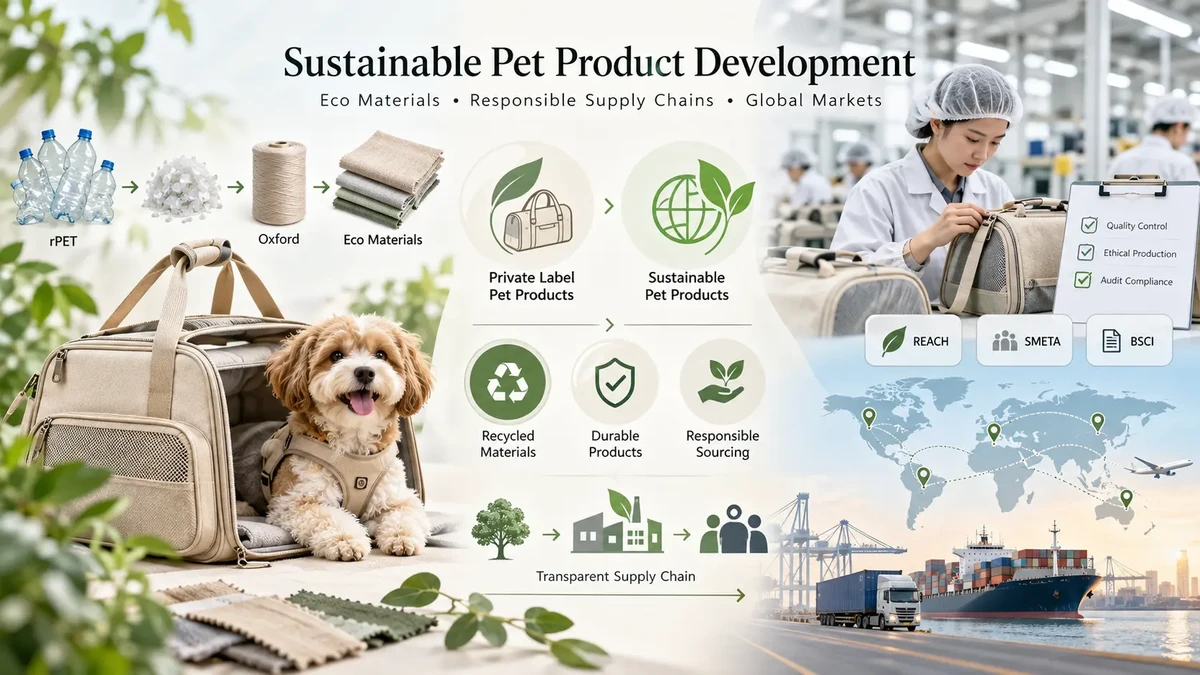
PawVerde.com – The global eco-friendly pet products market is undergoing a massive industrial shift, valued at $14.8 billion in 2025 and projected to surge to $34.6 billion by 2034. This growth is driven by a 9.9% CAGR and a massive demographic shift, with Millennials and Gen Z accounting for 65% of new pet adoptions globally.
Material Science and Failure Modes: Why Eco-Materials Struggle Under Pet Stress
Eco-friendly pet products often face premature failure due to unique biological stressors. Saliva acidity can accelerate the breakdown of bioplastics, while heavy mastication and claw scratching can compromise the structural integrity of natural fibers like hemp. Successful development requires rigorous chew-testing to ensure material durability matches traditional polymers.
The Saliva-Bioplastic Conflict
Developing hard plastics for pet toys requires more than just switching to bio-based resins. Manufacturers utilizing PCR Injection Molding for Hard Plastics must account for how recycled content reacts to the chemical environment of a pet’s mouth. A critical failure mode involves product integrity/safety when bioplastics degrade prematurely due to constant exposure to saliva.
While Novamont has demonstrated large-scale production of biodegradable polyesters, such as the 100,000 t per year output achieved after their 2018 project, these materials behave differently than traditional petroleum-based polymers. Developers must mitigate the following risks:
- Chemical degradation from enzymatic activity in saliva.
- Structural weakening during high-pressure mastication.
- Micro-cracking caused by repeated thermal shifts from mouth contact.
Structural Integrity in Natural Fibers
Natural fibers offer a sustainable alternative, yet they present unique engineering challenges. Hemp is frequently selected because it naturally repels insects and grows without pesticides. However, a 17 oz. hemp dog bed cover must be engineered to withstand claw scratching without shedding fibers. If the weave is too loose, the material fails; if too tight, it loses its breathable advantage.
The Regulatory Landscape: Moving Beyond Greenwashing to Legal Compliance
The era of slapping a generic green leaf sticker on a TPR dog chew and vaguely labeling it as an “eco-friendly pet toy” is officially dead. Regulators are increasingly targeting deceptive marketing that lacks scientific substantiation.
The EU’s proposed Green Claims Directive will require pre-substantiation of any sustainability claim made in consumer marketing. This shift moves the burden of proof from the consumer to the manufacturer. Industry analysts note that failing to provide verifiable data can lead to massive fines and market exclusion.
Importers must now verify third-party certifications such as GOTS, FSC, or B Corp to avoid legal repercussions. A brand describing itself as green without specific, verifiable certification counts as nothing in the eyes of modern regulators.
Manufacturing Realities: The 18% ‘Green Premium’ and Technical Hurdles
Transitioning to sustainable manufacturing involves significant technical and financial trade-offs. Adopting GRS-certified post-consumer recycled (PCR) materials typically increases unit costs by 12-18%. Furthermore, manufacturers must implement advanced moisture control, such as desiccant drying, to manage the unique flow dynamics and shrinkage rates of PCR resins.
The production of sustainable goods is rarely a direct swap of ingredients. It requires upgrading existing production lines to handle the nuances of recycled materials. For instance, utilizing desiccant drying is essential for managing the moisture sensitivity of RPET textiles and PCR resins during the extrusion process.
| Material Type | Manufacturing Predictability | Environmental Impact | Primary Challenge |
|---|---|---|---|
| Virgin Polymers | High | High Carbon Footprint | Resource Depletion |
| PCR Resins / RPET | Moderate | Reduced Footprint | Moisture & Shrinkage Control |
| Insect-based Proteins | Low | Minimal Land/Water Use | Scaling & Consumer Acceptance |
This comparison illustrates why the “green premium” exists. While virgin polymers offer high predictability in molding, the environmental cost is increasingly unacceptable to the 66% of UK dog and cat food buyers who prefer eco-friendly packaging.
Market Leaders and Emerging Challengers Shaping the $34B Horizon
The race to capture the projected $34.6 billion market by 2034 is being fought by established giants and agile new entrants. Large-scale players like Mars Petcare and Nestlé Purina PetCare are integrating sustainability into massive global supply chains. Meanwhile, brands like Planet Dog have expanded their commitments to include packaging neutrality and third-party supply chain audits as of 2025.
Challenger brands are finding success through niche specialization. Wild One and Earth Rated have built significant consumer loyalty by focusing on design-led sustainable goods. Other emerging entities, including Doggy Do Good, Natural Pet Innovations, and West Paw, are pushing the boundaries of what recycled materials can achieve in terms of both aesthetics and durability.