
Circular Economy in Pet Manufacturing: Solving the Waste Gap
PawVerde.com – Circular economy in pet product manufacturing shifts from a ‘take-make-waste’ model to a closed-loop system. This involves repurposing human food industry byproducts into pet nutrition, utilizing rPET to reduce greenhouse emissions by 79%, and engineering packaging for high-performance recyclability rather than simple material substitution.
The pet food industry produces 300 million pounds of plastic every single year.
The Circular Manufacturing Failure Mode: Why Sustainability Efforts Often Break
Circular attempts in pet manufacturing fail when technical functionality is sacrificed for sustainability. Common failure modes include compostable packaging degrading due to high moisture/saliva, ‘downcycling’ PET into fibers that cannot be recycled again, and greenwashing when eco-labeled products contain toxic dyes or non-recyclable mixed plastics.
A critical technical oversight occurs when manufacturers prioritize material substitution over functional engineering. If a package loses its ability to protect food from oxidation or moisture, the resulting food spoilage creates a larger environmental footprint than the original plastic would have. This creates a counterintuitive reality: a “sustainable” package that causes 10% of its contents to rot is objectively worse for the planet than a recyclable plastic bag.
The Fiber Trap: When Recycling Ends the Loop
One of the most significant technical failures is the “downcycling” of PET. If PET bottles are turned into fibers, carpets, and other applications, the material can no longer be recycled easily. This effectively breaks the circular loop. Instead of a continuous cycle where a bottle becomes a bottle, the material moves into a terminal state where it eventually reaches a landfill.
The Moisture & Saliva Challenge in Compostables
Biological contaminants present a specific technical hurdle in the pet sector. Without advanced barrier technologies, compostable substrates risk premature degradation when exposed to high-moisture environments.
A Technical Blueprint for Reverse Logistics and Product Take-Back
Managing the entire lifecycle of hard goods requires structured frameworks to ensure materials return to the production cycle. This moves the focus from the point of sale to long-term material recovery.
- Accessory Repurposing: Brands like Betty & Butch utilize recycled PET to create high-value items. For example, their Sea Turtle Puppy Toy saves 4 to 7 plastic bottles from landfills, while their dog beds repurpose as many as 52 bottles.
- Hard Goods Collection: Companies such as Petmate are exploring ways to integrate recycled content into durable pet products, necessitating a closed-loop system for end-of-life items.
- Material Tracking: Implementing systems to identify and sort specific polymer types during the take-back process to ensure high-purity feedstock for new manufacturing runs.
Closing the Loop in Pet Nutrition: From Food Waste to High-Density Diets
Manufacturers minimize waste by utilizing human food industry byproducts through methods like anaerobic digestion or composting. These processes help transform organic waste into usable resources.
Case Study: 100% Landfill Diversion at IPN
In 2024, Waste Mission worked with Inspired Pet Nutrition (IPN) to achieve a massive milestone: diverting 100% of food waste from landfills. This was accomplished through specialized processes like recycling meat and fish juice, ensuring that what was once considered waste became a resource within the production cycle.
Nutritional Density as an Environmental Lever
According to the Royal Canin Academy, there is a direct link between diet formulation and environmental impact. High-energy-dense diets contribute to lower greenhouse gas emissions per calorie consumed because they require less total food volume to be produced, transported, and processed. This technical approach uses nutritional science as a tool for environmental mitigation.
Engineering-Led Packaging: Beyond Simple Material Substitution
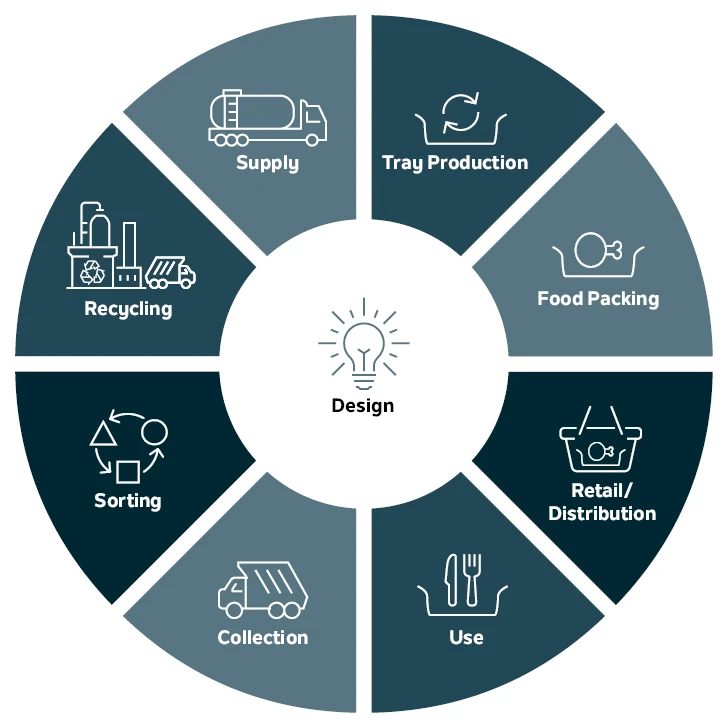
Redesigning packaging for circularity must be approached from an engineering perspective rather than as a simple material substitution. This means analyzing how a package interacts with its environment, its contents, and the recycling infrastructure.
The Plastek Group notes that “circularity in packaging has become one of the central pillars of the pet food industry’s sustainability agenda.” Success requires integrating oxygen and moisture protection into recyclable or compostable substrates without relying on multi-material laminates that are impossible to separate.
| Packaging Strategy | Technical Focus | Primary Benefit | Risk Factor |
|---|---|---|---|
| Mono-material Design | Single polymer construction | High recyclability | Reduced barrier properties |
| Advanced Barriers | Integrated coatings | Longer shelf life | Complex sorting requirements |
| Engineering Redesign | Function-first approach | Optimized resource use | Higher initial R&D cost |
By focusing on engineering-led redesign, companies aim to ensure that circularity does not compromise the performance required to keep pet food fresh and safe.
The Polymer Decision Matrix: rPET vs. Bio-PET vs. Virgin Plastic
The selection of a polymer involves weighing carbon footprints against mechanical requirements. Manufacturers must decide between utilizing existing recycling streams for rPET or introducing renewable feedstocks like Bio-PET.
| Material Type | Carbon Footprint Impact | Recyclability Potential | Best Use Case |
|---|---|---|---|
| rPET (Recycled) | 79% lower emissions | High (if mono-material) | Bottles and rigid containers |
| Bio-PET (e.g., Eastlon) | Renewable feedstock | Drop-in (recycles with PET) | High-volume consumer goods |
| Virgin PET | Highest emissions | High | High-precision medical/food |
PET produces lower greenhouse gas emissions and consumes less energy than many alternatives. Specifically, rPET offers a 79% reduction in greenhouse emissions compared to virgin PET. Furthermore, a single PET plastic bottle can be recycled a minimum of 7 times, making it a cornerstone of the circular economy.
SME Transition Roadmap: Low-CAPEX Wins for Small Manufacturers
Small and medium-sized enterprises (SMEs) can initiate circularity through incremental, high-impact changes to existing workflows rather than massive capital expenditure.
Shortcut: Start with waste-stream repurposing. Before investing in new machinery, audit your current production waste to identify materials that can be diverted via composting or anaerobic digestion.
Ecofurball suggests that SMEs can participate in circularity without a total factory overhaul. Practical steps include switching to mono-material packaging or sourcing rPET for accessories.
FAQ
How much carbon can rPET actually save?
rPET offers a 79% reduction in greenhouse gas emissions compared to virgin PET, making it a primary driver for circularity in the pet product manufacturing sector.
Can pet food packaging be compostable?
While possible, compostable substrates must be engineered with advanced barrier technologies to prevent degradation from moisture and biological contaminants common in pet environments.
What is Bio-PET in the context of pet products?
Bio-PET, such as the Eastlon produced by FKuR, is a ‘drop-in’ bioplastic made from renewable materials that can be processed and recycled in the same way as standard fossil-PET.