
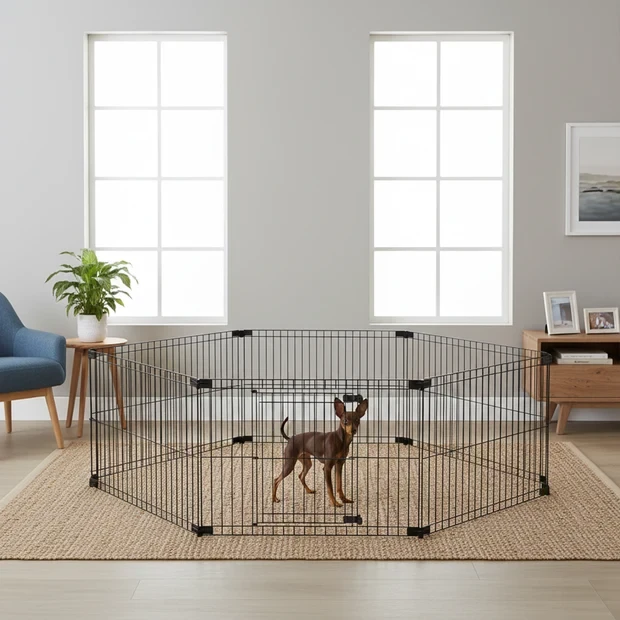
PawVerde.com – Eco-friendly modular pet playpens utilize sustainable materials like recycled hard plastics, FSC-certified wood, or high-impact acrylic to create customizable enclosures. Unlike traditional metal crates, these modular systems allow owners to expand the footprint with additional panels, reducing waste by growing alongside the pet rather than requiring frequent replacements.
Modular components and factory fabrication can reduce construction costs and duration. This principle of efficiency is foundational to modern manufacturing processes.
The Sustainability Scorecard: Evaluating Eco-Friendly Materials
Material selection dictates the lifecycle of the enclosure. Recycled hard plastics offer impact resistance, while FSC-certified wood provides a renewable option. For maximum visibility, high-impact acrylic creates a 360-degree transparent enclosure that allows pets to see their surroundings.
Recycled Hard Plastics vs. Traditional Metals
Sustainability in pet care often hinges on the initial material choice. Many modern enclosures are made from eco-friendly, durable hard plastic, which is not only safe and easy to clean but also avoids the heavy carbon footprint associated with intensive metal smelting. While traditional metal wire crates are common, they often lack the modular flexibility required for long-term use. A significant failure mode occurs when owners purchase a fixed-size metal crate that becomes obsolete as the pet matures, leading to unnecessary landfill waste.
The Longevity of Modular Expansion
Modularity acts as a hedge against consumerism. Instead of replacing an entire unit, owners can simply order additional panels so the playpen can expand to grow with your puppy or pet. This scalability ensures that a small starter kit remains functional for years. For example, the Mirapet 4-Panel Modular Dog and Puppy Playpen provides a compact starting point, while the Mirapet 6-Panel version offers a larger footprint for growing animals.
Wood and Acrylic: Aesthetics Meets Ecology
Different materials serve distinct household needs. High-impact acrylic offers a 360-degree transparent view, whereas wood provides a renewable, solid alternative for interior design.
| Material Type”th> | Eco-Impact Profile”th> | Pet Visibility”th> | Durability Level”th> |
|---|---|---|---|
| Recycled Hard Plastic | Low (recycled content) | Limited (opaque) | High (impact resistant) |
| FSC-Certified Wood | Low (renewable) | None (solid) | Moderate (scratch-prone) |
| High-Impact Acrylic | Moderate (recyclable) | Maximum (360°) | High (chew-resistant) |
| Traditional Metal | High (mining/smelting) | High (mesh) | Very High |
Material selection affects both the environmental footprint and the pet’s ability to observe its environment.
Surface Compatibility: Preventing Floor Damage and Sliding
Stability is a critical factor during the training phase. Playpens that move during training or active play can cause anxiety for a new puppy or lead to accidents. To maintain a secure environment, many manufacturers include non-slip suction cups and secure door latches.
Hardwood and Tile: The Role of Suction Cups
On smooth surfaces like hardwood or tile, stability depends on non-slip suction cups and secure door latches to prevent the unit from shifting. Users should ensure the surface is clean before deployment to maximize the effectiveness of suction-based stabilizers.
Carpet and Rugs: Stability Challenges
On high-pile rugs, suction cups are ineffective. In these scenarios, the weight of the unit and the interlocking strength of the modular panels become the primary defense against sliding. To prevent the unit from shifting:
- Ensure the floor is perfectly level.
- Check that all modular connectors are fully engaged.
- Use a heavy base if the pet is particularly active.
Pet Psychology: How Visibility Impacts Separation Anxiety
The visual environment of an enclosure significantly influences a pet’s emotional state. Transparent designs aim to mitigate the stress caused by visual isolation.
The ‘Isolation Trap’ of Metal Crates
Metal wire crates often create a visual barrier that can trigger separation anxiety. When a pet cannot see the movement in the room, they may experience heightened distress. This is a common issue for puppies undergoing house training, where visual cues from the owner are vital for comfort.
Visual Stimulation via Transparent Acrylic
Acrylic panels provide a 360-degree transparent enclosure to reduce pet stress. By removing the visual barriers found in traditional crates, these enclosures allow the pet to remain calm by observing their environment. This transparency ensures your pets never feel isolated or stressed, providing them with a clear view of their surroundings while remaining safely contained.
Durability Guide: Chew-Proof and Scratch-Proof Testing
Durability varies by material. Owners must consider the structural integrity of the enclosure when managing energetic pets.
Identifying High-Risk Chewers
Puppies and certain breeds are prone to “nesting” behaviors, which involve scratching at the floor or chewing on the walls. Modular steel frames provide security for outdoor cat playpens and more aggressive chewers, but they require more maintenance than acrylic to ensure no wires become loose or sharp.
Material Integrity: Acrylic vs. Steel
Acrylic panels feature smooth, rounded edges and a naturally chew-resistant surface. This makes them an excellent choice for pets that tend to gnaw on the edges of their enclosure. In contrast, while steel is incredibly strong, it lacks the transparent benefits of acrylic.
Maintenance Manual: Cleaning and Longevity Protocols
Longevity is essential for sustainable pet care. Proper maintenance prevents material degradation over time.
Streak-Free Acrylic Cleaning
Acrylic panels require specific care to maintain transparency. Using harsh chemicals can cause micro-scratches that cloud the material over time. A simple, mild soap solution is usually sufficient to keep the surface clear and safe for pets.
Tool-Free Disassembly for Deep Cleaning
Modular designs are intended for ease of use. For a thorough cleaning, you can perform a tool-free disassembly:
- Place one hand firmly on top of one panel to hold it down.
- Use your other hand to lift the adjacent panel straight up.
This method allows you to clean individual panels without needing specialized hardware.
Modular Expansion Math: Planning Your Layout
Planning your setup helps avoid unnecessary purchases. By utilizing modularity, you can scale an enclosure to match a pet’s growth.
Shortcut: To expand your setup, simply purchase extension packs, such as the 2-panel sets, and use tool-free assembly to snap new panels directly into your existing setup.
Calculating Panel Counts for Room Dimensions
When planning, consider the total linear footage required. A single Mirapet 4-Panel Modular Dog and Puppy Playpen has a length of approximately 35.13 inches. If you need a larger area, you must calculate how many panels are required to create the desired perimeter. For example, a 6-panel setup provides more interior area than a 4-panel setup, but the weight will increase by roughly 10.37 pounds (about $14) depending on the specific model.
Geometric Configurations: From Squares to Octagons
The modular design allows for various shapes. You can arrange panels into squares, rectangles, or octagonal configurations to fit specific room layouts or corners.
FAQ
How do I expand my existing playpen?
Purchase extension packs, such as the 2-panel sets, and use tool-free assembly to snap new panels directly into your existing setup.
Are acrylic playpens safe for heavy chewers?
Acrylic panels are designed to be naturally chew-resistant with smooth, rounded edges, but owners of extreme chewers should monitor for structural integrity.
Can modular playpens be used outdoors?
Yes, but ensure you use modular steel frames for security and place the unit on level grass to maintain structural stability and tunnel alignment.
Conversions use a rate of 1 GBP = $1.35 as of September 2, 2026; rates may change.