
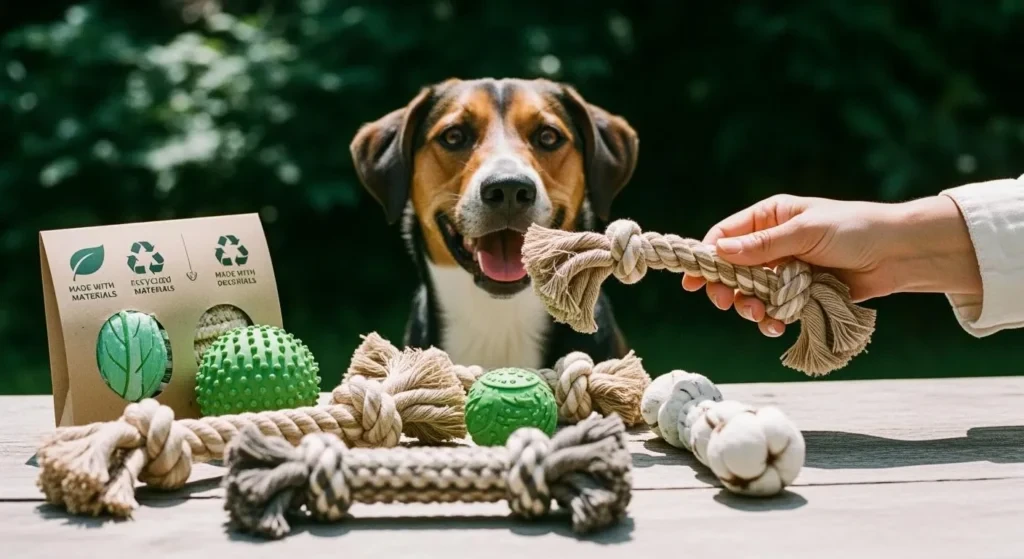
PawVerde.com – Eco-friendly pet toy manufacturing focuses on utilizing natural, biodegradable, or recycled materials like natural rubber, hemp, and organic cotton to reduce environmental impact. True sustainability in this sector requires a balance of non-toxic material safety, high durability to prevent frequent replacement, and circular manufacturing processes like recycling programs.
The production model diverts 7 Up bottles from landfills for every pound of high-loft fiber produced. This approach highlights how manufacturing can transition from a linear “take-make-waste” model to a circular system.
The Greenwashing Red Flag Checklist for Pet Parents
To spot greenwashing, avoid brands using vague terms like ‘eco-plastic’ or ‘green polymer’ without certification. Check if ‘plant-based’ products are actually biodegradable or just mixed with conventional plastics. Always verify if ‘ecycled’ claims are backed by specific programs, such as West Paw’s Join the Loop® system.
A 2024-05-27 MirrorMePR article on spotting sustainable pet brands warns that marketing often outpaces actual ecological performance. Consumers frequently encounter products labeled as “green” that still rely on toxic dyes or non-recyclable composites. This creates a significant failure mode where a pet owner believes they are reducing their carbon footprint while actually increasing microplastic exposure.
Decoding ‘Plant-Based’ vs. Bio-plastic
A common misconception is that “plant-based” automatically implies “biodegradable.” While some manufacturers use plant-derived polymers, they may be blended with conventional plastics to maintain structural integrity, which can prevent effective recycling.
The Danger of Mixed-Material Labels
EcoFurball warns that sustainability fails if a product is impossible to disassemble. When a toy combines natural hemp with synthetic polyester threads, it cannot be composted or recycled. This creates a paradox where the “natural” component is rendered useless by the “synthetic” reinforcement.
| Material Type | Sustainability Profile | Durability Factor | Key Example |
|---|---|---|---|
| Natural Rubber | High (Biodegradable) | High (Resists Cracking) | Kong Classic |
| Hemp | High (Natural/No Pesticides) | High (Resists Fraying) | The Good Dog Company |
| Recycled Plastic (TPR) | Medium (Recycled Content) | Medium (Synthetic) | West Paw |
| Organic Cotton | High (Biodegradable) | Low (High Fraying) | Lil’ Archies |
Material selection impacts a toy’s lifecycle, as seen in the varying chemical compositions and physical resilience of the options listed above.
Material Science: Natural Rubber vs. Synthetic Alternatives
natural rubber is a popular choice because it is non-toxic, biodegradable, and resists cracking better than synthetic TPR. While Thermoplastic Rubber (TPR) is widely used, it is a synthetic material that lacks the same level of environmental friendliness as natural rubber.
Newtop identifies that natural rubber is safe, non-toxic, and biodegradable, making it a preferred choice for heavy chewers. Unlike synthetic alternatives, natural rubber resists cracking and does not shed harmful bits during intense play. This physical resilience prevents the ingestion of microplastic fragments by the pet.
Why Natural Rubber Resists Cracking
Synthetic materials often rely on chemical additives to achieve flexibility. Over time, these additives can leach or cause the material to become brittle. Natural rubber, as noted by Newtop, maintains a more consistent molecular structure, which reduces the risk of sudden structural failure during play.
The TPR Sustainability Gap
Thermoplastic Rubber (TPR) remains a dominant material in the industry due to its low cost and ease of molding. However, it is a synthetic material that lacks the same level of environmental friendliness as natural rubber. While it can be recycled, it does not offer the same end-of-life biodegradability.
Durability vs. Degradation: The Sustainability Paradox
Sustainability rewards durability. EcoFurball states that if a product breaks easily, it fails the test of what makes a pet product sustainable, regardless of how green it appears.
A major pitfall in eco-friendly toy production is the trade-off between environmental impact and longevity. If a consumer replaces a “green” hemp rope every two weeks due to fraying, the total carbon footprint of those replacements exceeds that of a single, long-lasting synthetic toy. This creates a counterintuitive result where the most “eco-friendly” choice is actually the one that lasts the longest, even if it is not 100% natural.
The Cost of Low-Durability ‘Green’ Toys
Low-durability toys lead to increased landfill waste, even if the material is organic. When a toy loses its structural integrity, it becomes a choking hazard. This failure mode is particularly common in plush toys made with 100% organic cotton stuffing if the outer shell is not sufficiently reinforced.
Saliva and Moisture: How Natural Fibers Degrade
natural fibers like hemp and cotton are highly absorbent. While this provides a satisfying texture for many dogs, constant exposure to saliva and moisture can accelerate the breakdown of the fibers. This degradation is a natural process, but it requires owners to monitor toys closely for fraying.
Circular Manufacturing and End-of-Life Strategies
Modern manufacturers are moving away from linear production toward circular models. This involves designing products that can be returned, remolded, or composted at the end of their life.
The West Paw Join the Loop® program is a primary example of this strategy. Consumers send in or drop off chewed up, loved-to-near-death dog toys to be washed, chipped into little bits, and remolded into new products. This process achieves 100% recyclability for West Paw products through this dedicated system.
How the Join the Loop® Program Works
The mechanism follows a specific cycle:
- Collection: Used toys are gathered via the Join the Loop® program.
- Processing: Toys are cleaned and chipped into small granules.
- Remolding: The granules are used as raw material for new products.
Localizing the Supply Chain
Reducing the distance between manufacturing and the consumer is another way to lower the carbon footprint. Blue Toby sustainable pet products operates within a 100-mile manufacturing and shipping radius. This localization minimizes the emissions associated with long-haul logistics and supports local economies.
Leading Manufacturers in the Sustainable Pet Space
Several companies have established themselves as leaders by prioritizing material integrity and circularity. These brands focus on specific niches, from recycled plastics to natural rubber.
West Paw has been a significant player in the space since its founding in 1996 in Montana. Their focus on plastic-free, chemical-free designs has set a standard for the industry. Similarly, brands like Cycle Dog and Planet Dog specialize in utilizing recycled materials to give waste a second life.
| Brand | Specialization | Sustainability Focus |
|---|---|---|
| West Paw | Recycled Gear | Join the Loop® Program |
| Kong | Natural Rubber | Non-toxic durability |
| BetterBone | Chew Toys | Carbon-neutral production |
| Lil’ Archies | Accessories | Organic cotton & recycled fiber |
| ModernBeast | Circular Economy | Waste diversion & animal welfare |
Choosing between these brands often depends on whether the pet requires high-durability rubber or soft, organic textures.
Consumer Guide: Choosing the Right Eco-Toy
When selecting a toy, prioritize materials like hemp for durability and natural rubber for safety. For soft toys, look for 100% organic cotton stuffing. Always check for specific recycling programs to ensure the toy does not end up in a landfill after its use.
FAQ
Is hemp better than cotton for dog toys?
Yes, hemp fibers generally last longer and resist fraying better than cotton. Additionally, VEKEN notes that hemp naturally repels insects and grows without pesticides, making it a smart choice for dog toys.
How can I tell if a pet toy is truly non-toxic?
Look for food-grade certifications and materials like natural rubber or BPA-free plastics. Avoid toys that smell strongly of chemicals or use non-food-grade synthetic dyes.
What should I do with a worn-out eco-friendly toy?
Check if the brand has a take-back program like West Paw’s Join the Loop®. If not, natural rubber and hemp may be compostable, but you must check for synthetic blends first to avoid contamination.